Mastering the Sight Picture: A Shooter’s Guide to Rear Iris Apertures
In the arena of precision rifle shooting, consistency is the divider between a podium finish and a mid-pack placement. Whether navigating the tightly regulated conditions of a 10m air rifle match or adapting to the shifting environment of a 50m Three-Positions (3P) event, a shooter’s vision is their most critical asset. Yet, target ranges across the world are rarely uniform. Variations in indoor fluorescent tubes, harsh modern LEDs, outdoor glare, and overcast skies all threaten the crispness of a shooter’s sight picture.
To combat these variables, elite competitive shooters rely on high-precision adjustable rear iris apertures. Often referred to simply as “sight filters,” these sophisticated mechanical components thread directly into the rear diopter sight. By manipulating light transmission, spatial perception, and depth of field, they ensure that the front sight element and the target bullseye remain sharply defined.
This comprehensive guide breaks down the underlying optical physics of iris apertures and examines top-tier options from prominent brands like MEC Centra, Gehmann, and the homegrown Arjuna lineup available via Shooter Paaji.
The Optics of Precision: Why the Iris Matters
At its core, a rear iris serves two fundamental purposes: managing light volume and controlling depth of field.
Depth of Field and the Sweet Spot
Just like a camera lens, narrowing the aperture restricts the light cone entering the eye, which deepens the focus field. This optical trick allows the human eye to see both the nearby front sight ring and the distant target with optimal sharpness simultaneously. Most match rifle irises offer an adjustable diameter range of 0.8 mm to 1.8 mm.
While a smaller hole sharpens focus, closing it too far triggers a phenomenon known as light diffraction. Below a certain threshold, light waves bend around the edges of the aperture blades, distorting the sight picture and causing the target to appear fuzzy or webbed. Finding the “sweet spot”—typically between 1.0 mm and 1.3 mm—is essential to balancing crisp edges with adequate brightness.
Color and Contrast Filtration
Indoor shooting ranges are notorious for lighting variations. High-end apertures integrate optically flat glass filters to shift color temperatures and alter contrast. Different tints solve specific visual hurdles
- Yellow & Peach: Popular for indoor use, these tones warm up harsh light, increase focus stability, and make the black bullseye pop against a dull background.
- Grey & Dark Grey: Designed to act as sunglasses for your sight, balancing extreme brightness and minimizing eye strain under intense lights or outdoor glare.
- Blue (C41): Specifically engineered to enhance front sight rings and target edge clarity when shooting under artificial, cool LED lighting.
In-Depth Analysis of Top Competition Irises
Selecting the ideal aperture requires aligning its feature set with your specific shooting discipline, range environment, and budget goals. Below is an evaluation of the leading options featured on the Shooter Paaji platform.
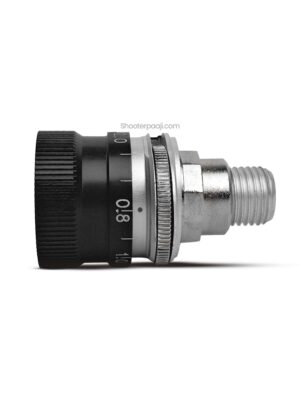
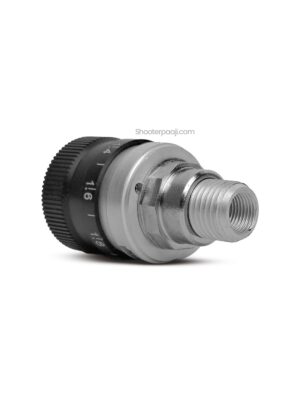
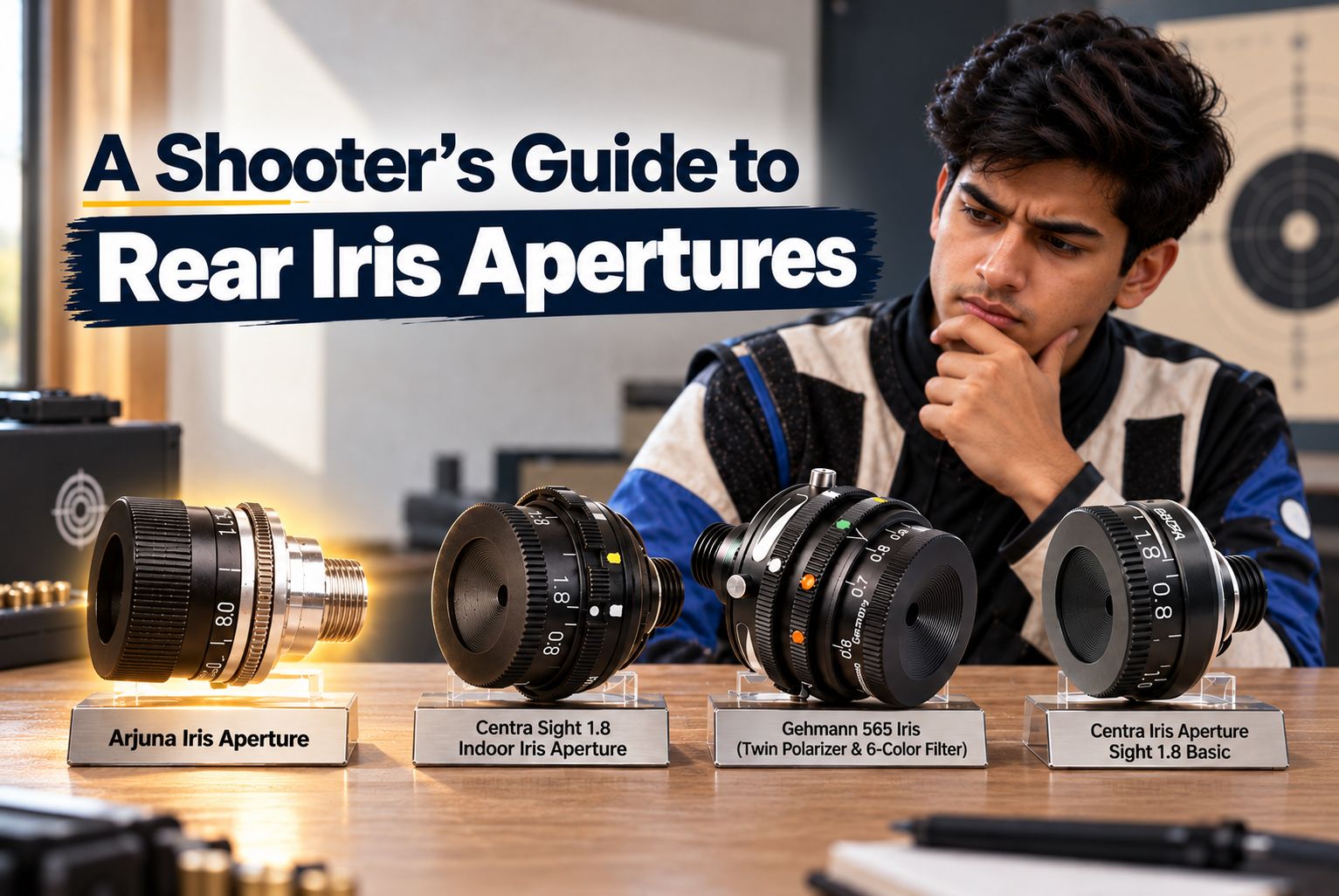
1. Arjuna Iris Aperture (Color Filter)
Developed directly by the team at Shooter Paaji, the Arjuna Iris Aperture was explicitly engineered to address the specific environmental hurdles faced by competitive shooters. It marks a significant achievement in domestic precision engineering.
- Compact Architecture: One of Arjuna’s defining features is its reduced frontal profile. By designing a smaller housing, it significantly improves a shooter’s spatial perception while in position, keeping peripheral awareness high and reducing visual claustrophobia.
- Micrometer Adjustment: The inner iris ring features micrometer-style click adjustments ranging from 0.8 mm to 1.8 mm, enabling smooth, minute adjustments to changing light.
- Integrated 5-Color System: It features polished optical glass filters consisting of Grey, Dark Grey, C41 Blue, Yellow, and Peach. These selections are tailor-made for high-performance contrast adjustments across both legacy and state-of-the-art electronic target ranges.
- Ergonomics & Build: Encased in a lightweight, CNC-machined, high-grade aluminum body, it features an integrated clamp element meant for attaching an eye blinder to eliminate distractions from the non-aiming eye. It uses a universal M9.5 x 1 thread, making it cross-compatible with virtually all standard international rear sights.

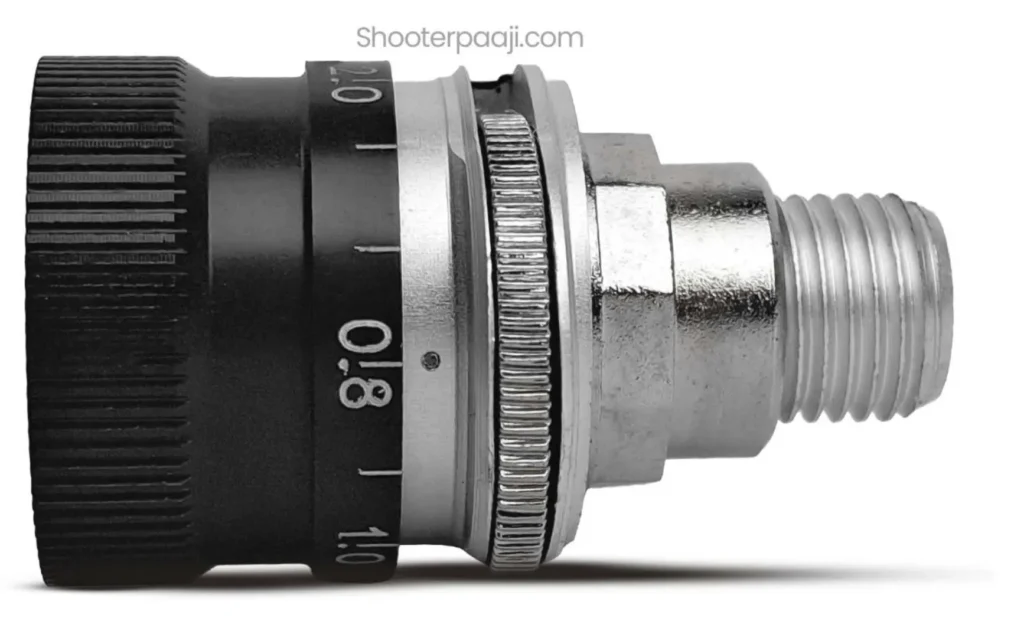
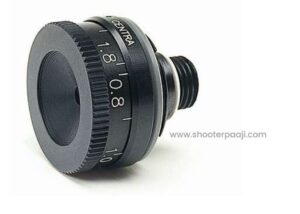
2. Centra Sight 1.8 Indoor Iris Aperture
MEC Centra is an international heavyweight in target sports accessory design, acting as a trusted direct supplier to major firearm brands like Walther. The Centra Sight 1.8 Indoor is built specifically for 10-meter air rifle shooters working within strictly indoor facilities.
- Elite Diaphragm Mechanics: This premium iris relies on a complex internal system composed of 15 overlapping discs, creating a near-perfect circular aperture throughout its adjustment range. A truly round aperture ensures symmetrical light distribution to the retina, eliminating subtle vertical or horizontal sight distortions.
- Indoor-Specific Filtration: The turret hosts a specialized 5-color glass filter matrix: Light Gray, Yellow, C41 Peach, C41 Blue, and C41 UV. The emphasis on UV and customized blue/peach tints helps normalize light temperatures across varying qualities of indoor range bulbs.
- Refined Control Rings: Newly updated color and polarization filter control rings boast a textured design that allows shooters to confidently click between filters or alter diameters while staying perfectly settled in their shooting jacket, without dropping the cheekpiece.
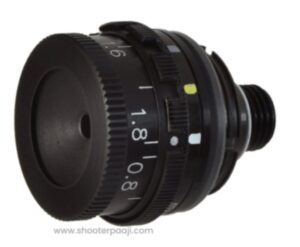
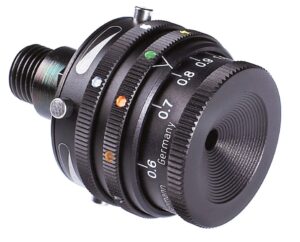
3. Gehmann 565 Iris (Twin Polarizer & 6-Color Filter)
For competitors seeking absolute control over light waves, the Gehmann 565 represents the pinnacle of micro-optics refinement. While fully usable for indoor air rifle shooting, its extensive capabilities make it a favorite for outdoor 50m Three-Positions (3P) events.
- Dual Polarization Power: Beyond its 6-color flat-glass filter disk (Orange, Light Green, Yellow, Medium Grey, Dark Grey, and Amethyst), the Gehmann 565 incorporates two independent polarization filters. The primary polarizer strips away outdoor glare and reflection off target faces, while the secondary ring acts as a variable neutral density filter, smoothly shading target brightness up or down without requiring a change in the physical iris diameter.
- Expansive Aperture Range: Unlike standard indoor versions, the 565 boasts an ultra-wide iris range stretching from 0.5 mm to 3.0 mm. This makes it incredibly versatile across outdoor daylight variations.
- Modular Engineering: It includes laser-engraved markings, a matt black anti-reflective internal coating, a locking collar for V-mark alignment, and a removable steel thread that allows the direct integration of a Gehmann 50309 magnifying diopter (-4.5 to +4.5 correction).

4. Centra Iris Aperture Sight 1.8 Basic
For developing shooters or clubs requiring premium performance without excessive adjustments, the Centra 1.8 Basic delivers core mechanical perfection.
- No-Fills Consistency: It completely strips away internal color filters and polarizers to focus entirely on precise iris adjustments from 0.8 mm to 1.8 mm. It is ideal for shooters who practice on a single, consistently lit home range and prefer an un-tinted, natural sight picture.
- Universal Fitting: Like its high-end siblings, it retains the premium internal construction, M9.5 x 1 threads, and integrated blinder clamp element, ensuring shooters do not compromise on fundamental durability.
Technical Comparison Matrix
To assist in matching a specific iris to your competitive needs, the table below highlights the crucial technical differences between the main options available at the Shooter Paaji store:
| Feature/Specification | Arjuna Iris Aperture | Centra 1.8 Indoor | Gehmann 565 Iris | Centra 1.8 Basic |
| Primary Discipline | 10m Indoor & 50m 3P | 10m Air Rifle Indoor | 50m 3P / Extreme Outdoor | 10m / 50m Entry-Match |
| Iris Adjustment Range | 0.8 mm – 1.8 mm | 0.8 mm – 1.8 mm | 0.5 mm – 3.0 mm | 0.8 mm – 1.8 mm |
| Number of Discs | Standard Multi-lens | 15 Precision Discs | High-Precision Multi-lens | Standard Multi-lens |
| Color Filters | 5 (Grey, Dk Grey, C41 Blue, Yellow, Peach) | 5 (Lt Gray, Yellow, Peach, Blue, UV) | 6 (Orange, Lt Green, Yellow, Med Grey, Dk Grey, Amethyst) | None |
| Polarization Layers | No | No | Twin Independent Polarizers | No |
| Housing Design | Ultra-Compact Body | Interchangeable Sight Covers | Gold Finish / Luxury Boxed | Lightweight Minimalist |
| Mounting Thread | M9.5 x 1 Universal | M9.5 x 1 Universal | M9.5 x 1 (Removable Steel) | M9.5 x 1 Universal |
| Blinder Integration | Integrated Clamp | Integrated Clamp | Locking Collar Compatible | Integrated Clamp |
Buying Decision Framework: Choosing Your Aperture
When choosing your rear iris attachment, base your final choice on the following three criteria:
- Environmental Variance: If you travel frequently to different competitive shooting ranges with unpredictable lighting setups, choosing an iris with integrated color filters like the Arjuna or Centra Indoor is paramount. If you transition between indoor air rifle and grueling outdoor smallbore matches, the Gehmann 565 provides unrivaled versatility.
- Spatial Comfort: Shooters who feel distracted or visually restricted by large rear sight profiles will benefit directly from the Arjuna’s compact body styling, which optimizes a broader field of natural peripheral vision.
- Purity vs. Adaptability: If you find switching between color modes distracting, opt for the mechanical purity of the Centra Basic. However, if you require extreme contrast tuning under severe fluorescent or LED glare, investing in a multi-lens layout featuring specialized blue or peach elements is a wise choice.